




























On-Metal RFID's Real Bottleneck Isn't the RF. It's the Printer.

Unreliable on-metal RFID read performance is a problem that’s been largely solved by innovations in tag design, including foam standoffs, detuned antennas, and shielded ground planes. Today, on-metal tags can be reliably read, even on demanding surfaces like titanium.
So why is on-metal RFID still one of the harder deployments to scale? This is because while innovations in tag design have solved the RF problem, they have created a secondary problem that gets much less attention—on-metal tags are difficult for printers to print and encode.
A Trade-off That's Easy to Miss on a Datasheet
All the properties that make an on-metal tag work on metal also make it more challenging to print and encode:
Firstly, the tags are thicker. With inlays needing vertical separation from the metal surface, foam or spacer layers are added. The result is that on-metal tags are usually in the range of 1–2 mm thick with the liner included — noticeably thicker than a standard paper label. Most desktop printer media-feed paths and printhead assemblies aren’t designed for these dimensions.
Secondly, on-metal tags are stiff. Rigid substrates and foam cores don't tolerate a tight bend radius. That's why on-metal media almost universally ships on 3" cores at around 8" OD instead of the 1" or 1.5" cores a desktop printer's internal media bay accepts.
What is more, their antennas sit in a specific plane, behind a specific shield. The ground plane that makes the tag work so reliably on steel also blocks RF from the underside. Printer encoding antenna position isn't a preference — it can determine whether the tag encodes at all.
Also, their liners are often oversized or irregular. Die-cut on-metal constructions frequently carry excess liner beyond the tag footprint, which is exactly what defeats a narrow-window gap sensor.
None of this is a defect. It's the physical consequence of the RF solution. But it means the industry has ended up with a three-way compromise at the point of issuance.
The Three Options
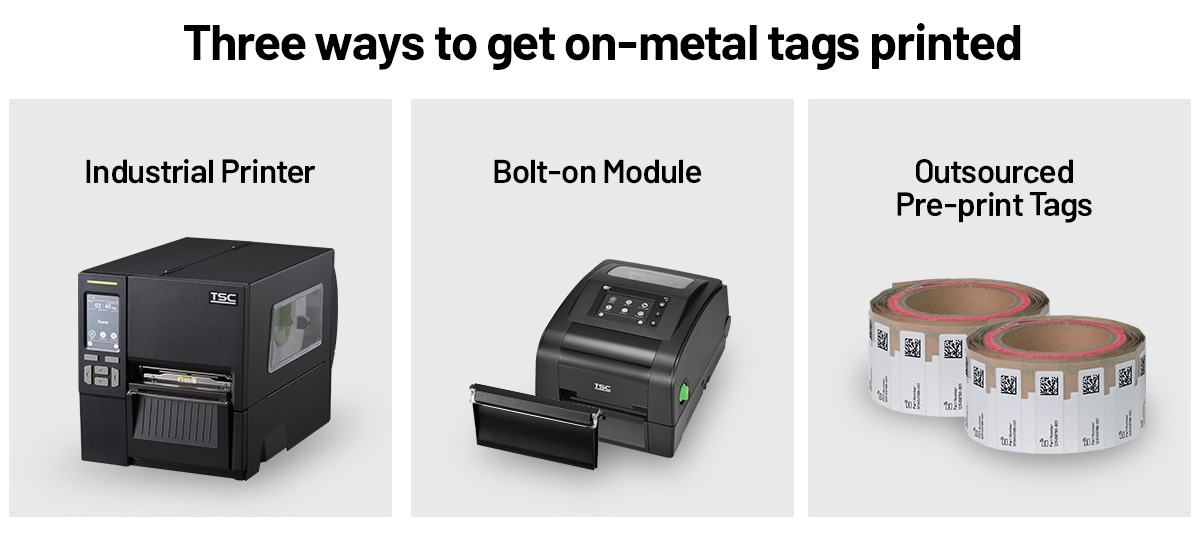
Option 1 — Buy a dedicated industrial on-metal printer: It works. It also means paying industrial CapEx and floor space for what is often a low-volume, intermittent application. And in a distributed model — a dozen repair stations, each tagging only a handful of parts a day — hardware costs can become prohibitive.
Option 2 — Add a bolt-on module to a desktop unit: Now you're managing a second SKU, extra procurement, and field services on an assembly that wasn't native to the platform. Most importantly, the risk of mis-encodings increases dramatically.
Option 3 — Outsource pre-printed, pre-encoded tags: Higher costs per label, highest operational cost. You lose on-demand issuance — and on-demand is often the entire point in MRO, where the part in front of the technician determines the data on the tag.
Here's the pattern worth noticing: the applications with the strongest need for on-metal are often the ones least suited to an industrial printer, such as aviation MRO, tool control, IT asset tagging, and settings where returnable metal containers are used. All distributed, all low-volume, all point-of-use. The bottleneck usually isn't read performance. It's that few organizations want — or need — a separate industrial printer at every bench.
Put the Capability in a Desktop
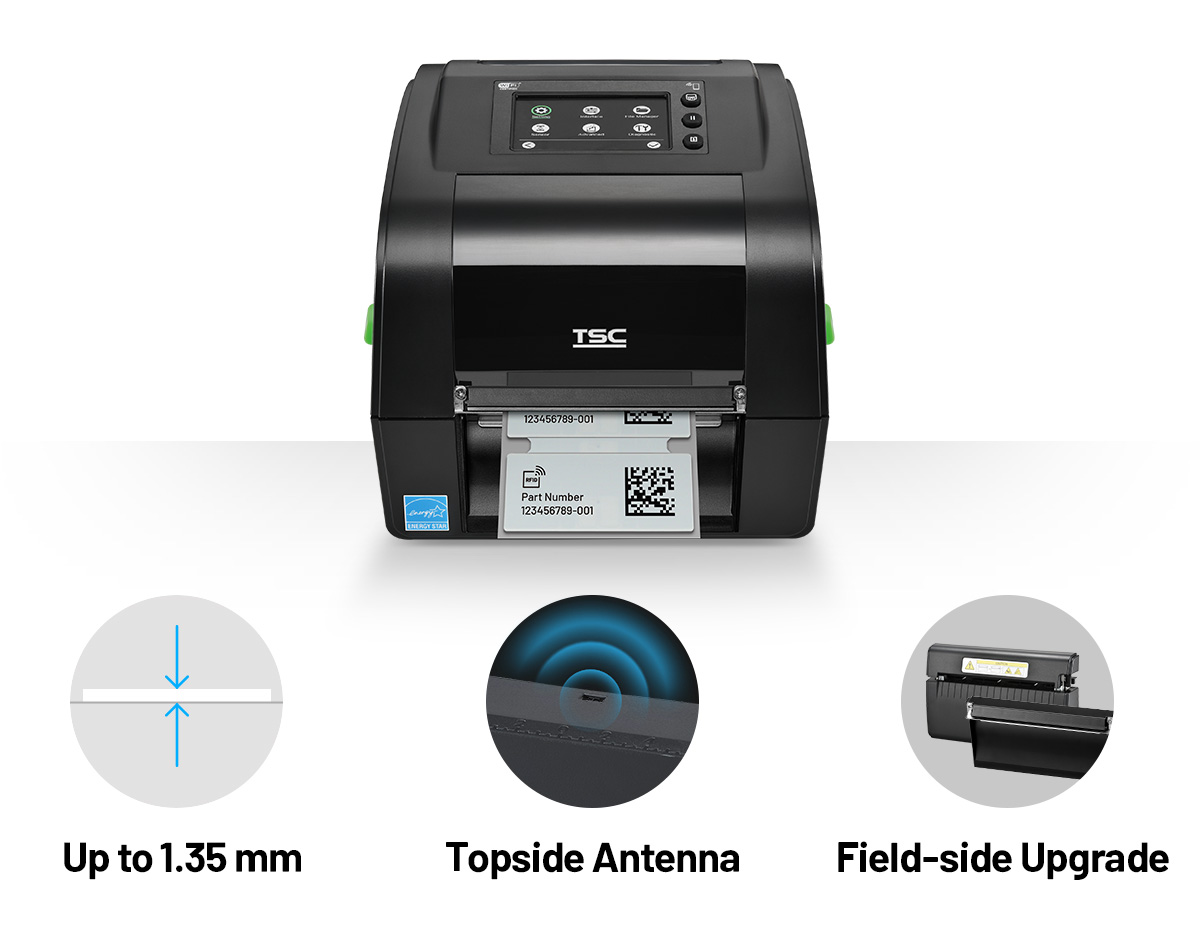
On-metal printing and encoding with a desktop form factor is achievable. We’ve built it into the TH Series. But "achievable" carries conditions, and we'd rather share the specifics than broad claims.
- Media thickness: up to 1.35 mm, tag plus liner. That covers most on-metal tags, which sit around 1.2 mm or below. It doesn't cover everything. Measure your tag with the liner on before assuming it fits — this is the single most common qualification issue we see.
- Media handling: plan for an external unwinder. On-metal rolls ship on 3" cores at roughly 8" OD, which doesn't fit a desktop media bay. Building the unwinder into the bench layout and the BOM from day one avoids a surprise later.
- Encoding plane: factory RFID TH models encode from below. This matches most current on-metal tag constructions, where the inlay antenna is accessible from the underside via either an opening in the ground plane or a wraparound tag construction. The factory RFID TH won't encode a tag design that requires topside encoding access. A topside encoding field kit is available.
- Gap sensing: 5 mm of travel on the right-hand edge. If your construction carries excess liner on the right side, the sensor may not see the gap. Two fixes: trim the liner, or source pre-trimmed media. Either is straightforward if it's decided during tag selection, and more disruptive if it's discovered during production.
Why We Say "Select On-Metal"
Within our RFID portfolio materials, our industrial platform is listed as supporting “On-metal.” The TH desktop line is listed as supporting “Select On-metal.”
That word is deliberate. It's the four conditions above, compressed into one qualifier — we chose to keep it rather than simplify it into a broader claim, because the conditions genuinely matter for whether a given tag qualifies.
If you're evaluating hardware for an RFID program, "supports on-metal" alone can be hard to act on as a procurement input. What helps more is the envelope: thickness ceiling, core and OD handling, encoding plane, sensing window. Those four values are usually enough to tell you in an afternoon whether your tag qualifies.
What This Actually Changes
Work within these conditions, and the economics of distributed on-metal tagging shift. On-demand encoding can move from a single industrial station to any bench that needs it. The per-site cost of entry drops to desktop class. Tag selection becomes a qualification step with four criteria, rather than an open question.
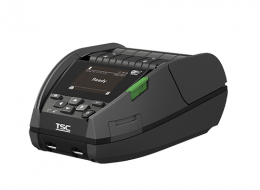
Fall outside the conditions — because your tag is too thick or your bench can't host an unwinder — then staying with an industrial printer, like the MB241, is the right call. That's a legitimate answer, and it's better to reach it before the PO than after.
On-metal RFID deployments often stall less because of read physics and more because of the issuance station—and because these constraints tend to surface later in a project rather than earlier.
So, what's your on-metal tag's stack thickness, with the liner on? If you don't know that number yet, that's a good place to start.